2026 Keynote Talks
Future University
Digital Research Conference, University of Edinburgh, ‘How do we Structure Knowledge? Interdisciplinarity, Challenge-Led Research and the Future University’ (26th Feb)
Edinburgh University General Council Keynote speaker, ‘Future University: New Infrastructures of Knowledge’ (14th Feb)
2025 Keynote Talks
Future University
Charnock Bradley Lecture (College of Medicine and Vetenary Medicine, University of Edinburgh), ‘One University: Towards New Infrastructures of Knowledge’ (21 May)
Una Europa (Jagiellonian University, Krakow): panel discussion, ‘The Future is Now!’ (27 May)
Oxford University Press webinar, ‘the Arts & Humanities as catalysts for interdisciplinary research’ (18 June)
Association of Research Managers & Administrators Annual Conference (ARMA 2025) keynote, ‘The University of the Future? Towards New Infrastructures of Knowledge’ (19 June)
Oriel College Oxford, Comparative Perspectives on Liberal Education: In the U.S., U.K., and Europe in the 21st Century; Teagle Foundation (25-26 June)
*****
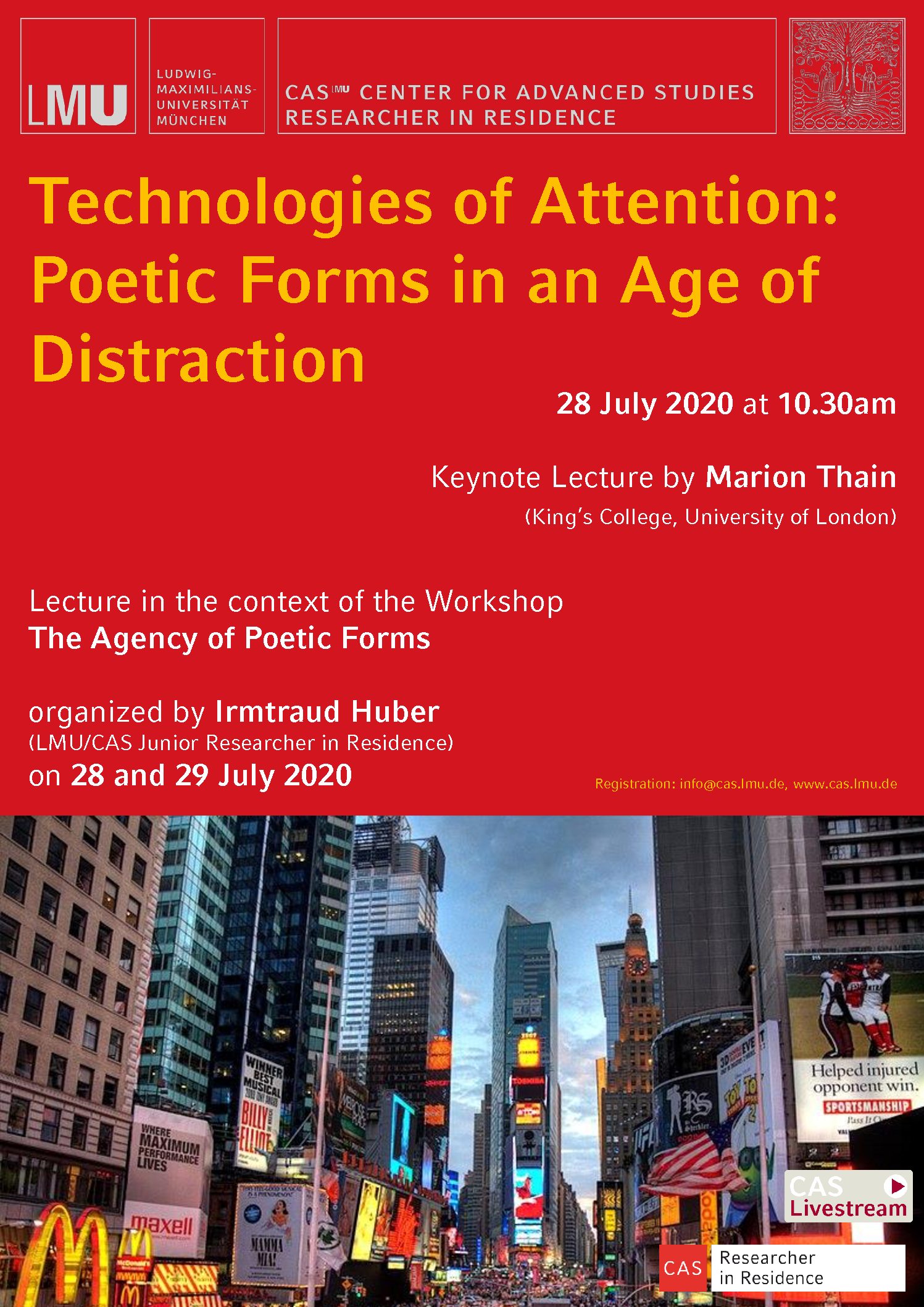
2020 Keynote Ludwig-Maximilians University, Munich (Germany)
See poster at the head of this page.
*****
2019 Keynote at International Network for the Study of Lyric
The Between-ness of Lyric / L’entre-deux lyrique / Lyrik im Dazwischen
INSL Second international conference, University of Lausanne, June 4-7, 2019
*****
2018 Geneva: ArtTech Forum
I will be speaking at this event on 11th-12th October 2018:
https://arttechfoundation.org/arttech-forum-2018/
‘For its second edition, in conferences and round tables at which high-level international figures will speak, the 2018 ArtTech Forum aims to bring together an international community of researchers, engineers and scientists, representatives from the sphere of culture and economy.’
*****
2018 BAVS Keynote Speaker
Keynote speaker at the British Association of Victorian Studies conference: 29-31 August 2018.
‘Cosmopolitan Forms: a Politics and Poetics of Decoration’
See their website here: [https://bavs2018.wordpress.com/]
Download the poster here: BAVS 2018 CFP
*****
2017 Transnational Poetics at University of Lausanne (Switzerland)
UNIL Research Seminar Series A17
*****
2017 Lyric Studies International Conference
‘Lyric and Modernity: Lyric Theory Outside the Canon’:
*****
2017 Arthur Symons Symposium
Keynote lecture (organized by Goldsmiths, University of London): London, 21st July 2017.
Download the flyer here: CfPSymonposium
*****
2016-17 CFP Distracted Reading
Call for Papers (Digital Humanities Quarterly)
Distracted Reading: Acts of Attention in the Age of the Internet
Central to the humanities is the theorisation and practice of modes of attention (to cultural artifacts and to other aspects of the world). Indeed, within our teaching spaces many of us devote much time to finding ways to redirect our students’ attention away from the distractions of their multiple electronic gadgets. But what if we consider how their distributed focus might enable new acts of attention and new ways of reading? How might we rethink pedagogy and our own research methods in an era of hyper-connectivity?
There is nothing new about distraction, but such questions have a particular relevance in light of recent models, such as those of the distributed cognition theorists, that describe our electronic devices as potential cognitive extensions of ourselves: what we think of as mind can be dispersed across objects external to our bodies. If this is the case, how might we think about the new potential these devices offer and the new methods they enable within humanities’ disciplines?
We invite submissions for a special issue of Digital Humanities Quarterly (DHQ) on this topic.
‘Reading’ should be taken to represent any act of critical engagement with works in any medium (text, visual art, film, or music, for example). Of particular interest are papers that connect research and pedagogy. Topics are certainly not limited to the following, but might include:
— the use of different digital tools simultaneously within a group of students or scholars to draw out and represent different aspects of one work (whether, for example, a painting, film, text or a piece of music) for analytic purposes
— the use of social networking tools to shape new acts of attention to our objects of study;
— the use of annotation software with groups of students, and the new research methods this might inspire (or vice versa)
— the use of spatial and distributed modalities to better comprehend or represent what are usually thought of as linear modes of reasoning (critical, philosophical, historical, or others); for example, the possibilities packages such as prezi offer for representing spatial relationships between concepts or ideas.
Deadline for abstracts: January 31st 2017
400 words; submitted as a Word doc. attachment.
Send to marion.thain[at]nyu.edu.
Deadline for full papers: July 31st 2017
Word limit: 7,000 words
Style: inline author-date references, with a full list of works cited at the end (footnotes used only for digressions and explanations)
Submission format: Word
(http://openjournals.neu.edu/ojs/index.php/dhq/about/submissions#authorGuidelines)
Send to marion.thain[at]nyu.edu.
*****
2016 Swinburne Conference
I will be presenting a response to the conference and its major concerns at the end of the final day:
Poems and Ballads 150th Anniversary Conference
Cambridge, 29-30 July 2016
Conference website: https://swinburne2016.wordpress.com/
*****
2016 Florence Keynote Lectures: Aesthetes in Italy
‘Bernard Berenson’s “Tactile Values” and a History of Embodied Cognition’; The British Institute of Florence (25 May 2016). Download poster here: Thain Tactile Values
‘British Aesthetes in Italy: Digitizing Cultural Exchange in the Late Nineteenth Century’; Associazione Culturale Il Palmerino (24 May 2016). Download poster here: Thain Berenson and Field
*****
2015-17 Distracted Reading Collective
Distracted Reading Collective: Acts of Attention in the Age of the Internet
Central to the humanities is the theorisation and practice of modes of attention (to cultural artifacts and to other aspects of the world). Indeed, many of us devote much time to finding ways to redirect our students’ attention away from the distractions of their multiple electronic gadgets. But what if we not only instruct our students in other (older?) acts of attention, but also consider how their distributed focus might enable new acts of attention and new ways of reading? How might we rethink pedagogy — and as a consequence our own research methods — in an era of hyper-connectivity?
This project brings together those already considering such questions and those who are interested in doing so, to devise and share experimental methods of teaching and researching. For example: how might we practice detailed analysis (of art, film, text or music) though the combined resources of multiple media simultaneously; how might apps and/or networking tools be used to shape new acts of attention to our objects of study; how might we better comprehend or represent lines of reasoning (critical, philosophical, historical, and others) through spatial and distributed modalities?
The plan
A consortium of faculty will undertake experiments in our teaching and/or research over the Spring semester (2016). The experiment might take place in one teaching session, or it might be sewn into a course across the semester, or it might be part of your research or creative practice.
The Outcome
I will be publishing some posts on a new NYU DH blog for anyone who would prefer to contribute in that way. The project will run over the Spring semester (spring 2016) and will result in a symposium at NYU in 2016-17, to which all participants are invited.
Interim Event:
Tuesday, April 26th 2016, from 6:15-7:15, in the Tech Training Room, Liberal Studies, NYU
Have you ever felt your students have a compulsive attachment to their electronic devices? Are we sometimes fighting a losing battle in the classroom to focus attention away from these multiple distractions? What new opportunities might this scenario offer?
The Distracted Reading project asks how we might harness modes of distracted attention for innovative pedagogical practices, and/or as inspiration for new scholarly research methods or creative practice. A university-wide (and beyond) project, the aim is to bring together both those who are already experimenting with such methods and those who would like to know more, to share experience and expertise.
This informal interim event (featuring faculty from LS currently involved in the project) offers an exclusive preview, and a chance to join the conversation. Whether you are a creative practitioner or a scholar we would like to hear your thoughts.
RSVP: Marion Thain (marion.thain@nyu.edu)
*****
2014 Thomas Hardy Conference
Keynote address at The Thomas Hardy Conference 2014
Download programme here: Conf Main Prog.pdf June 2014
*****
2014 Michael Field Centenary Conference
The Michael Field Centenary Conference: New Directions in Fin de Siècle Studies
11th-12th July 2014
Download conference Poster: michael-field-conference-poster
*****
2014 Digital Humanities Colloquium (AHRC-funded)
Digital Humanities Colloquium, 16-17 June 2014
Funded by the Arts and Humanities Research Council, U.K.
PI Professor Francis O’Gorman (Leeds)
Co-I Dr Marion Thain (Sheffield)
Administrator Thomas Mandall
Subject – Victorian Lives and Letters Consortium (VLLC)
As part of a major project in nineteenth-century digital curation, we are holding a two-day AHRC-funded Research Network colloquium at the University of Leeds on 16-17 June. The event is designed to introduce the VLLC, a new large-scale manuscript digitization project involving ourselves and partners in the United States, and bring together a group of experts to discuss the latest developments in the field, including:
- a) technical development;
- b) partnerships with libraries, archives, and universities;
- c) financial sustainability;
- d) editorial standards and academic development
Colloquium Programme
Monday 16th June:
11.00 Launch of VLLC project and outline of the Big Issues
12.30 Lunch
1.30 Content: focal writers, copyright, archival relations, imaging, balance of the project as a whole, intellectual coherence, digital curation etc.
3.00 Alliance Issues: defining roles and protocols for the stakeholders — academic institutions, archives, cultural institutions.
4.00 tea
4.30 User groups and audience: Impact, crowd-sourcing, building the bridge between the stakeholders and the public etc.
6.00 – 7.00 wine reception
Tuesday 17th June:
10.00 technical issues: content management, metadata, data preservation, encoding standards, extensibility, interconnectivity.
11.30 tea
12.00 funding plans: possible funders and funding plans; financial sustainability etc.
1.00 lunch
2.00 Postdoc and PhD roundtable: with an eye to the future
Invitation to Participate
AHRC-funded Colloquium, 16-17 June 2014: School of English, University of Leeds
(PI Professor Francis O’Gorman (Leeds); Co-I Dr Marion Thain (Sheffield); Administrator Thomas Mandall)
As part of a major project in nineteenth-century digital curation, we are holding a two-day colloquium. The event is designed to introduce the VLLC, a new large-scale manuscript digitization project involving ourselves and partners in the United States. The event will bring together a group of experts to advise us on the development and enhancement of the project, including in terms of
- a) technical development;
- b) partnerships with libraries, archives, and universities;
- c) financial sustainability;
- d) editorial standards and academic development
Major figures internationally and nationally in nineteenth-century editing and curation, as well as senior figures in digital humanities, will be present. Please see the draft schedule of events here:
https://sites.google.com/a/nyu.edu/marion-thain/dh-colloquium/draft-programme
We have space to accommodate a small audience of colleagues interested in being part of this event; if you are able to contribute expertise or if who would simply like to learn more about current practice in the field we would be pleased to hear from you. There is no charge for this event, but space is limited so if you would like to attend please email us as soon as possible.
Yours sincerely,
Francis O’Gorman and Marion Thain
f.j.o’gorman@leeds.ac.uk; m.thain@sheffield.ac.uk